What to Expect From a Reliable Pallet Supplier
Quick Answer
A reliable pallet supplier does more than deliver pallets. They help you lock in the right specifications, keep quality consistent across loads, support volume and repeat orders, and reduce damage and downtime with dependable builds and delivery.
What a Pallet Supplier Actually Does
Most people think a pallet supplier simply sells pallets. In reality, a good supplier becomes part of your operation’s rhythm.
A true pallet supplier should be able to:
- Provide consistent pallets that match your workflow and equipment
- Support repeatable supply for recurring shipments
- Help you avoid surprises like fit issues, racking problems, or inconsistent build quality
- Communicate clearly on lead times and availability
- Scale when your demand spikes, without cutting corners
If your operation depends on smooth handling, predictable storage, and fewer damaged loads, the pallet is not a commodity. It is infrastructure.
The “Reliable Pallet Supplier” Checklist
Use this quick checklist when evaluating a supplier or re-evaluating your current one.
1) Spec clarity
A supplier should confirm:
- pallet footprint and height
- stringer vs block design
- entry requirements (2-way vs 4-way)
- deck board thickness and spacing
- load expectations and handling conditions
If a supplier is vague about specs, you are likely to feel it later through breakage, poor fit, or inconsistent performance.
2) Consistency across runs
Consistency matters when:
- you ship to multiple locations
- you have multiple shifts and multiple forklift operators
- you rely on racking or predictable stacking
- you work with automation or tight tolerances
The best pallet suppliers build in a way that keeps output repeatable, not just “good enough today.”
3) Scale and responsiveness
A supplier should be able to support:
- recurring orders
- volume needs
- non-standard demands that still show up in bulk
This matters most when you are planning production. You want a supplier that can keep up without you having to babysit the process.
4) Storage and material handling practices
If your pallets need to stay clean and dry, the supplier’s storage capacity matters. Product stored under cover helps reduce moisture exposure and keeps your pallets and lumber in better condition.
5) Delivery reliability
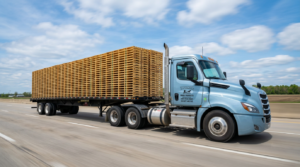
Delivery is part of supply. Some buyers want to know whether a supplier has their own fleet, what coverage looks like, and how deliveries are handled when priorities shift.
Looking for a supplier that checks all five boxes?
Troymill works through that same checklist with every buyer before a single board is cut, then walks through your spec and handling conditions with someone who builds this every day.
Common Problems a Good Pallet Supplier Helps Prevent
If you are dealing with any of these, your supplier relationship is not doing what it should.
- pallets that do not fit racking or storage patterns
- inconsistent deck spacing causing forklift issues
- breakage during handling or transport
- damaged product due to weak or inconsistent builds
- stop and start supply that disrupts scheduling
- unclear communication when lead times change
Typical Timelines Buyers Ask About
Every supplier is different, but buyers usually want clarity around:
- how quickly quotes and drawings can be turned around
- standard versus expedited production timelines
- how fast lumber and dunnage can be sourced when needed
- whether build-and-hold programs exist for recurring customers
Clarity here reduces back-and-forth and helps both sides plan more confidently.
Pallet Suppliers – FAQs
FAQ 1: What is a pallet supplier?
A pallet supplier provides wood pallets to support shipping, storage, and handling. A strong supplier also helps confirm pallet specifications, maintain consistency across orders, and support repeatable supply for ongoing operations.
FAQ 2: What should I look for in a reliable pallet supplier?
Look for spec clarity, consistent build quality across runs, predictable availability, clear lead-time communication, and reliable delivery. If your pallets vary from load to load, it usually shows up as damage, handling friction, or downtime.
FAQ 3: What is the difference between a pallet supplier and a pallet manufacturer?
A manufacturer builds pallets. A supplier may manufacture, source, or do both. The practical difference is whether they can deliver the right spec consistently, at the volume you need, with dependable communication and delivery.
FAQ 4: How do I know if my pallet spec is correct?
If you are seeing product damage, forklift handling issues, racking problems, or inconsistent stacking, your spec may not fit your workflow. The best way to confirm is to review load requirements, handling method, storage conditions, and the exact pallet build details.
FAQ 5: Why does pallet consistency matter for warehouses and manufacturers?
Consistency reduces forklift handling issues, improves stacking stability, supports racking requirements, and lowers damage risk. In multi-site operations, inconsistent pallets can create downstream problems across multiple facilities.
FAQ 6: What causes pallets to fail even when they look fine?
Common causes include improper forklift entry, overhang loads without support, incorrect racking spans, impact at the dock, and inconsistent build quality. Many failures are workflow-related, not just material-related.
FAQ 7: How do I choose between new and recycled pallets?
New pallets are often preferred when you need tighter consistency, stronger performance, or compliance requirements. Recycled pallets can be a fit for closed-loop shipping, lighter loads, and cost-sensitive use cases. The right choice depends on your system, not just price.
FAQ 8: Do I need heat-treated pallets?
Heat treatment is typically needed for export compliance or customer requirements. If you ship internationally or have compliance standards, ask about heat treatment availability and what your shipment requires.
FAQ 9: How quickly can a pallet supplier provide quotes and drawings?
Many buyers expect fast turnaround on quotes and drawings so projects can move forward without delays. The key is getting clear specs and requirements up front so the supplier can respond accurately.
FAQ 10: What questions should I ask a pallet supplier before placing an order?
Ask about pallet type, entry requirements, board thickness and spacing, expected load conditions, storage environment, production consistency, lead times, and delivery approach. Also, confirm how changes or reorders are handled so the build stays repeatable.
The pallet is infrastructure
The pallet is infrastructure. The supplier behind it should be, too. Troymill has spent three generations building both. Our 50-acre Middlefield, Ohio, facility produces approximately 50,000 pallets per week, with on-site ISPM 15 heat treatment available on request, a private fleet running the Midwest, Mid-Atlantic, Southeast, Texas, and parts of Canada, and the consistency that comes from doing this for decades.
Request a quote or call us at 440-632-5580, and we will start with your spec, your workflow, and the conditions that actually drive performance.