Custom Pallets in Volume: Standard vs Non-Standard Sizes Without the Headaches
Quick Answer
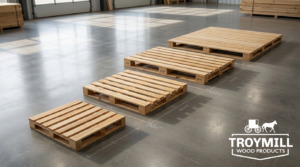
Custom pallets should not mean one-off, small runs. In many operations, “custom” really means non-standard sizes produced in volume to fit a specific product, handling method, or supply chain requirement.
Custom Does Not Have to Mean Small
A common misconception is that custom pallets are a niche request for small orders. In many real-world supply chains, non-standard pallets are the norm.
The key difference is this:
- one-off custom pallets are typically small-batch, highly specific, and often not repeatable
- non-standard pallets in volume are repeatable, scalable, and built to support everyday operations
The second category is where many manufacturers and distributors live. They move multiple loads per day and need non-standard sizes that match product dimensions, warehouse constraints, or customer requirements.
When a Standard Pallet Works Best
Standard sizes like 48″ x 40″ exist for a reason. They are often ideal when:
- you have shared storage and handling systems
- pallets move through multiple facilities
- you need broad compatibility for forklifts and racking
- the product footprint fits cleanly without overhang
Standard pallets reduce complexity when your system is built around standard handling.
When Non-Standard Sizes Make More Sense
Non-standard pallets become the better choice when:
- product dimensions cause overhang or instability on standard pallets
- you need a specific stacking pattern for shipping density
- your customer requires a unique footprint
- you need specialty packaging outcomes for long-haul or higher-value loads
- you are using oversized pallets for larger products or unique loads
These are not “special projects.” They are operational requirements.
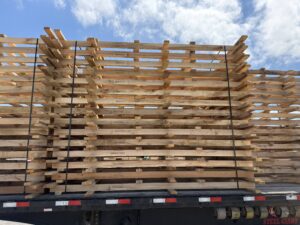
Troymill manufactures non-standard pallet sizes alongside 48×40 GMA standard runs at over 50,000 pallets per week, with the same consistency and lead time discipline either way.

How to Think About Custom Pallets Without Creating Chaos
Instead of “Do we need custom pallets?” a better question is:
What does our system require to move product consistently and safely?
Five questions to confirm before customizing
- What is the product footprint and weight distribution?
- How will it be handled (forklift entry patterns, clamp, conveyors, etc.)?
- Will it be stored in racking, stacked, or floor-staged?
- How far does it travel, and what failure risks are most common?
- Is this a repeatable need that will show up weekly or daily?
When those questions are answered, custom becomes an engineering and operations decision rather than a guessing game.
If those questions surface gaps that are harder to answer cleanly than expected, that is what an engineering conversation is for.
Troymill produces non-standard pallets at truckload volume every day, and we will walk through your spec, your handling method, and your load conditions before anything is built. Request a quote.
Why Oversized Pallets Matter
Oversized pallets are a practical solution when:
- products exceed standard footprint requirements
- stability is compromised on standard sizes
- damage reduction is more valuable than cost reduction
- the supply chain requires a footprint that is not negotiable
The goal is not to be different. The goal is to be consistent. Check out our Custom Pallets page.
Custom Pallet – FAQs
What are custom pallets?
Custom pallets are pallets built to a specific footprint, design, or performance requirement to match a product and workflow. In many operations, custom refers to non-standard sizes produced consistently at volume.
What is the difference between custom pallets and one-off custom orders?
One-off custom pallets are small runs for a unique request that may not repeat. Custom pallets in volume are repeatable, scalable builds used every day to support ongoing shipping and handling needs.
When should I use a standard pallet size like 48”x40”?
Standard pallets are often best when your workflow is built around standard handling, shared storage systems, and broad compatibility. If your product fits cleanly and performs well on standard sizes, standard usually reduce complexity.
When do non-standard pallet sizes make more sense?
Non-standard sizes are often the better choice when product dimensions create overhang, instability, inefficient stacking, or customer-specific footprint requirements. They are common in manufacturing and distribution, where repeatable non-standard sizes are part of the system.
Are custom pallets always more expensive?
Not always. If a custom pallet reduces product damage, improves shipping density, prevents downtime, or eliminates rework, the total cost can be lower even if the pallet price is higher.
What information does a supplier need to build custom pallets correctly?
At minimum: product footprint and weight distribution, handling method, storage method, travel conditions, and whether the need is repeatable. The more clearly these are defined, the more consistent the build will be.
What are oversized pallets?
Oversized pallets are pallets with a footprint larger than standard sizes. They are commonly used when products exceed standard dimensions, need added stability, or require a non-negotiable footprint for shipping or storage.
How do I avoid custom pallets that create problems later?
Confirm how the pallet will be handled, stored, and transported in real conditions. Then keep the build consistent across runs so performance is repeatable. A custom pallet only helps if it performs consistently every time.
What should I prioritize when designing a custom pallet?
Prioritize fit to the system: stable load support, forklift entry compatibility, stacking and racking needs, and durability where impacts occur. Avoid changes that do not solve a real handling or damage problem.
How do I know if I need custom pallets or just a different standard pallet type?
If your main issues are overhang, load shifting, damage, or workflow friction, custom sizing may help. If the problem is mostly due to handling behavior or storage conditions, a spec adjustment or a process change may solve it without a fully custom pallet.
Troymill manufactures non-standard pallet sizes at truckload volume, with standard build times of approximately 10 business days, expedited builds in approximately 5 business days, and quotes returned within 24 hours.
Request a quote, and we will start with the spec, the workflow, and the conditions that actually drive performance.