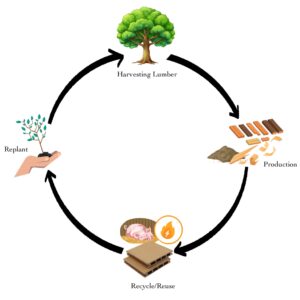
The wood product lifecycle: harvest responsibly, manufacture efficiently, recycle or reuse materials, and replant to renew forests.
At Troymill Wood Products, waste isn’t wasted, it’s transformed. Every piece of wood that enters our facility has a purpose, from full-size lumber to small particles of sawdust. As one of Ohio’s most trusted pallet wood suppliers, we’ve built a production model that turns wood packaging waste into energy, animal bedding, and even new materials. We’ve created a closed-loop system that benefits both business and the environment.
Turning Wood Packaging Waste into Opportunity
Woodworking naturally produces byproducts like sawdust, bark, and cutoffs. In a traditional manufacturing setting, these materials are often discarded, which adds disposal costs and environmental burden. Here at Troymill, we take a different approach.
By strategically capturing and reusing these materials, we reduce landfill waste, lower operating costs, and improve energy efficiency across our operations. Our goal: make sure every board, chip, and flake contributes to something useful.
Sawdust Uses: Small Particle, Big Impact
One of the most versatile byproducts in the lumber industry is sawdust. Troymill’s sawdust is collected, filtered, and directed to secondary markets and applications such as:
Energy Production: Used as a renewable fuel source in biomass energy systems, turning residual material into heat and power.
Animal Bedding: Ideal for livestock and equestrian facilities thanks to its absorbency and natural composition.
Composite Materials: Combined with resins to form particleboard, MDF, and other engineered products used in construction and packaging.
These applications show that sawdust is not merely a byproduct but an essential ingredient in a more sustainable pallet production ecosystem.
Cutoffs and Trim: Reusable Components for Bulk Supply
Larger wood cutoffs are repurposed for secondary manufacturing, including pallet components and industrial lumber. Rather than discarding imperfect or undersized boards, Troymill processes them into usable forms for:
Bulk pallet wood for sale
Custom pallet components
Crate and packaging material production
This approach enables our customers to receive reliable, high-quality wood products while minimizing the environmental impact of our operations.
Energy Recovery Using Wood Byproducts
Beyond product reuse, Troymill’s facilities are engineered for energy recovery. We capture wood dust and shavings to fuel on-site heating systems. This practice reduces reliance on fossil fuels and keeps our production process efficient, warm, and clean.
This closed-loop energy model reflects our commitment to sustainable manufacturing, demonstrating that efficiency and eco-consciousness can work in harmony.
Sustainable Pallet Production
As conversations about urban wood utilization continue to grow, more businesses are recognizing the importance of sustainable resource recovery. Across industries, companies are taking meaningful steps to operate more responsibly, and at Troymill, we share that same commitment.
The organization Forest Proud captures this vision perfectly:
“Recovering and reclaiming wood waste helps us build and grow local wood economies, create jobs, store carbon, and position cities to achieve sustainability and climate resiliency goals. Each new product and business built around urban wood creates a story and product that connects trees in our communities to homes and people in a tangible way. It drives community and employment revitalization and reduces wood waste, all while reimagining our cities—and our urban wood streams—as opportunities for innovation and climate solutions.”
Every stage of our operation, from raw timber to recycled sawdust, reflects Troymill’s commitment to responsible resource use. By turning wood packaging waste into new value, we show that sustainability drives both progress and purpose in everything we do. See how Troymill’s byproducts fuel sustainability initiatives.
FAQs
What is pallet wood waste used for?Troymill utilizes pallet wood waste to be repurposed into animal bedding, biomass fuel, mulch, and composite materials, such as particleboard.
Is sawdust eco-friendly?Yes, it is, when managed responsibly. Since sawdust is a natural byproduct that can be recycled, it’s biodegradable and renewable, making it an eco-friendly resource when properly reused.
Do pallet wood suppliers reuse scrap materials?The best suppliers, like Troymill, have systems in place to capture and repurpose every usable piece of wood. This reduces landfill waste and helps maintain sustainable operations.
Can I buy bulk pallet wood made from reclaimed or recycled materials?Absolutely. Troymill offers bulk pallet wood for sale, incorporating reclaimed materials whenever possible.
How does recycling wood byproducts help the environment?Recycling byproducts reduces deforestation, cuts landfill emissions, and lowers the energy demand associated with processing new raw materials, therefore supporting a more circular, low-waste economy.